

What if the single biggest factor determining your GCC's success isn't talent, technology, or even cost— but the operating model you choose on Day 1? Most global enterprises underestimate this, and only realize it years later when their GCC either becomes a powerhouse of innovation… or gets stuck as a low-impact support center.
Setting up a Global Capability Center (GCC) is one of the most strategic decisions an enterprise can make today. With global markets shifting, technology cycles compressing, and cost pressures rising, the right operating model becomes the engine that determines whether a GCC becomes a value creator or merely a support extension. As more companies transform their GCCs into innovation hubs and growth accelerators, choosing the right structure isn't just an operational question—it's a strategic one.
This comprehensive guide explores the Top 5 Operating Model Options for modern GCCs, breaking down how each structure works, when to choose it, and what business advantages it brings. Whether you're building your first center, scaling an existing one, or evaluating a transition, understanding the right operating model is the foundation for success.
Every GCC leader knows this: the blueprint you start with decides how fast you can scale, innovate, and integrate with the global enterprise. A well-designed operating model is not just about org charts and workflows—it determines talent quality, cost efficiency, governance maturity, and the overall impact your center will create.
Before exploring the top options, let's understand how an operating model shapes:
In many ways, the right operating model is the backbone of modern Global Capability Centers, helping them evolve from basic delivery engines into strategic pillars of enterprise transformation.
Adding to this, Deloitte reports that around 40% of India's 1,400+ GCCs are R&D centres, and nearly 50% of the GCCs established in the last five years focus on digital and R&D capabilities—reinforcing how critical the operating model is in shaping innovation maturity.
Below are the most successful, proven models used globally. Each is designed to serve different priorities—speed, compliance, innovation, cost optimisation, or deep integration.
The fully captive approach is the most traditional and widely adopted operating model for multinational firms. In this structure, the parent organization owns, operates, and controls the GCC end-to-end, similar to running a captive unit within the global organization.
A fully captive center is ideal for companies that require:
This operating model allows complete autonomy—recruitment, infrastructure, compliance, and technology are all fully controlled. The ability to shape organizational culture from day one also makes this model attractive for companies building advanced engineering, analytics, or product teams.
However, the model requires significant management bandwidth and upfront financial commitment. For companies with clear long-term vision and resources, it becomes a powerful way to build proprietary capability and deep institutional knowledge.
In this increasingly popular operating model, the GCC is partially managed by the enterprise and partially by a specialist partner. This offers the perfect balance between ownership and flexibility.
Here's how it works:
A hybrid operating model is ideal for organizations that want to start fast, reduce operational load, and transition smoothly without compromising control. It is also used by firms entering new geographies or building niche functions where talent availability fluctuates.
This structure helps companies integrate quickly into a gcc hub ecosystem, leveraging the partner's maturity in processes, tools, and local governance.
In this operating model, a specialist partner sets up the GCC on behalf of the enterprise, operates it for a defined period, and then transfers the center once it reaches stability and scale.
This model is excellent for companies that want:
The BOT approach is ideal for enterprises who eventually want to own the center but prefer a transition path that reduces risk. During the initial years, the partner ensures your GCC runs efficiently, compliant with local laws, and structured with global best practices.
Once transferred, the enterprise enjoys a fully functional, scalable operation that aligns seamlessly with global standards. The BOT operating model often accelerates maturity by 2-3 years compared to traditional setups.
This operating model allows enterprises to run their GCC like an extended managed service. Here, the GCC partner is responsible for workforce management, infrastructure, operations, governance, and output delivery—while the enterprise sets the vision and performance outcomes.
This structure offers:
Companies with limited leadership availability or those wanting a lean oversight model choose this structure. It is also suitable for firms shifting from decentralized internal teams toward a consolidated global shared services engine.
The partner brings standardized processes, tools, and pre-configured GCC maturity frameworks. For many businesses, this operating model becomes the quickest path to productivity without compromising on quality or compliance.
The CoE-driven operating model is ideal for enterprises building advanced capabilities in analytics, engineering, cybersecurity, cloud, or product development. Here, the GCC operates like a specialized innovation powerhouse, often complementing headquarters teams.
In this structure:
Many companies also use this model to expand their R&D center footprint globally. With the right talent ecosystem and leadership, CoE-based GCCs evolve into strategic engines that redefine enterprise capabilities and accelerate transformation.
This shift is strongly supported by industry data. KPMG notes that adoption of advanced digital capabilities inside GCCs has accelerated dramatically—AI/ML and data science adoption increased from 65% in FY19 to 86% in FY24, while cybersecurity adoption jumped from 55% to 88% during the same period. This surge clearly demonstrates why more enterprises are transitioning their GCCs into CoE-led structures to drive innovation at scale.
This model requires strategic vision, leadership autonomy, and an innovation-focused culture. But when done right, it elevates the GCC's role far beyond a cost centre or operational support unit.
Selecting the correct operating model is not a one-size-fits-all decision. It depends on six critical dimensions:
The right operating model is the one that aligns long-term goals with short-term operational realities.
Today's GCCs are undergoing a massive shift. The earlier focus on cost arbitrage has evolved to capability ownership, innovation velocity, and enterprise transformation.
Companies are using GCCs to run:
Modern GCCs are no longer support units—they are core value creators. With the right operating model, they can deliver continuous business impact, innovation, and resilience.
Whether you want to create a specialized capability center, a cross-functional hub, or a multi-country operating engine, your GCC strategy can unlock long-term enterprise advantage.
This is also why organizations increasingly seek GCC solutions that offer end-to-end frameworks for talent, tools, governance, and transformation.
Your GCC's success depends on how well your ambitions align with the operating model you choose. Each model—from fully captive to BOT to CoE—offers unique advantages, and the right fit depends on your industry, maturity, and transformation goals.
As global footprints expand, the role of Global Capability Centers will only grow. Choosing the right structure ensures scalability, agility, and long-term innovation. A well-designed operating model is the difference between a GCC that merely functions and one that drives enterprise-wide impact.
At Anlage, we offer end-to-end GCC solutions—from strategy and setup to scale and governance—to help you build world-class centers with speed and confidence.
Ready to begin your GCC journey? Contact us and we'll guide you end-to-end.
An operating model defines how your GCC is structured, governed, staffed, and managed. It determines decision-making, cost efficiency, talent quality, and how seamlessly the center integrates with global teams.
There is no one-size-fits-all choice. Companies seeking speed may prefer Hybrid or BOT models, while organizations focused on control, IP protection, and long-term capability building typically choose a Fully Captive or CoE-driven model.
Depending on the operating model, it can range from 3-6 months for a hybrid or managed GCC, to 12-24 months for a fully captive structure that requires deeper setup and integration.
Yes. As the GCC matures, many companies transition from partner-led or BOT models into fully captive or CoE-driven structures to scale innovation and IP ownership.
A partner brings proven playbooks, talent access, compliance readiness, and faster time-to-value. Anlage provides end-to-end GCC solutions—from strategy and setup to scaling and governance—helping enterprises build world-class centers efficiently.
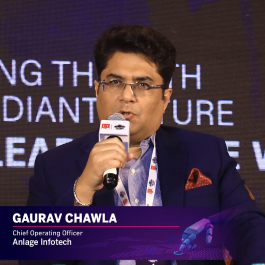

Gaurav Chawla, COO of Anlage Infotech, emphasized the transformative role of AI-powered analytics in HR at the 5th Edition of the GCC Summit 2024. Highlighting predictive analysis and smart tool utilization, he shared how these technologies can cut hiring cycle times by up to 60%, driving greater efficiency. The event took place at GMR Aerocity Hyderabad.
READ MORE

